Raise your hand if you’ve ever been bored or felt disconnected in class.
We get it. Much of what students study seems long ago and far away. They’re required to read books, plays, and poems written by people from before their time, and so they often discount what they’re studying as unrelatable because they were not involved in it themselves. What a great opportunity, then, to get a hands-on (or up and gesturing) experience!
Students from the Program for the Deaf and Hard of Hearing classes provided just that to my seventh grade Language Arts classes in room 125 last Friday afternoon.
To give you context, my students had just completed their reading/performance of William Gibson’s The Miracle Worker. This play shows a journey of learning with Helen Keller, a child struck deaf and blind by illness when just a toddler, and her (thankfully) obstinate teacher, Anne Sullivan. Together, they unlock a world into language and learning, but not without an inordinate amount of struggle.
To supplement the play, we’ve read a little about Anne Sullivan and the American Disabilities Act (ADA) of 1990. I’ve also shown a few videos about deaf students learning to dance, and how to communicate using American Sign Language (ASL), but learning without a screen is often better than learning with one.
Seeking out an experience with a more human touch, I reached out to a few teachers in the program, and had the opportunity to ask Ms. Amanda Lazaro and Ms. Sarah Sales a little bit about their roles at our school.
Lazaro shared, “My job title is Teacher of the Deaf. It’s a very specific subset of Special Education. I’ve been with Bergen County Special Services as a ToD since 2009. I worked at the program for the Deaf and Hard of Hearing in Midland Park for a long time and came to start the new program in Emerson last year.”
Sales explained that she is an ASL interpreter who started in October of this past year.
I asked what had drawn them to this career, and Lazaro replied, “I knew I wanted to become a teacher very early. I was maybe 12 or 13 when I decided I wanted to be a teacher. In high school, I was able to take a sign language class and really loved it. When it came time to look at colleges, I saw that Education of the Deaf and Hard of Hearing was offered as a major. I thought ‘I can do both?!’ I’ve been doing that ever since!”
Sales said, “I studied ASL in college and went to school to become an interpreter. I used to work as an aide at a school for the Deaf, so being back in a school environment was something I enjoyed.”
As a fellow teacher, I had to ask them what was most rewarding about their jobs. I was pleased with, but not surprised by, their responses.
“I think most teachers can relate when I say my favorite part of my job is watching students have their ‘Aha moment’. I love seeing students make connections and learn new things! I always say my 2 most favorite sounds on Earth are the laughter of my children and a student saying ‘OOOOH!’ when they finally understand something,” said Lazaro.
Sales agreed, “I love it when the students are able to ask for clarification on something and then see the look of understanding when everything clicks because they are really learning.”
How about those challenges?
Lazaro clarified, “Again, I would say the challenges are similar to what any teacher would face. Fighting the battle against screens for students’ attention is a big one. However, a unique challenge to teaching Deaf students is how easy it is to catch them not paying attention! With hearing students, they can not be looking at you and still be getting what you are saying. With Deaf students who sign, you know they are missing information the moment they look away.”
Sales admitted the most challenging part for her is, “Being able to adapt to each student when working in a group, because deafness is a spectrum. All of our students have different needs and approaches that work best, so when in a group it can be challenging.”
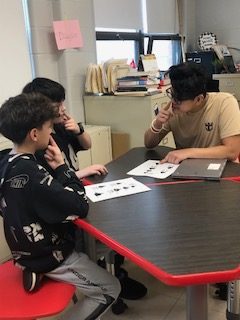
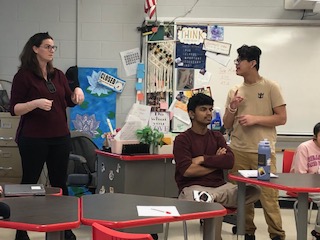
Teacher talk aside, the students were (and are) the real teachers, and after introducing themselves, they made sure to circulate around the room and assist their pupils with the ASL alphabet and a few basic signs for “How are you?”, “Fine”, “Happy”, etc. using a printed worksheet and their years of personal expertise. It was interesting to notice a hush fall over the class, and then watch as fingers flew into shapes of letters, and hands flattened and curved with meaning.
We learned about “name signs”, and how you are given one by a deaf friend, not a hearing one or yourself. Your name sign could be the first letter of your name, or a physical/character attribute, or hobby/talent. One of our guest teachers, Ashley, uses the sign for “art” for her name because of her love of drawing and painting. Another uses “sweet” for her name sign. (It is easy to see why. I see you, Mia!) A few of my girls left with their own name signs before the period had ended. I’ll be honest, I’m a little jealous. Where’s mine?
Most of the program’s students shared that they had learned sign language in school. Some sign in Spanish as well. This led to a great discussion about how there are different sign languages depending on assorted countries and regions. We also talked about African American Vernacular English ASL (AAVE ASL). Ms. Sales (the agile and amazing interpreter) brought up that there was a sign language interpreter for Bad Bunny’s Super Bowl Halftime Performance that used Puerto Rican sign language.
Who knew? Show of hands!
A little hesitant at first, my inquisitive students asked questions like:
“Is it hard to learn other languages in sign language?”
“Are you able to hear anything without your hearing aids or cochlear implants?”
“If you’re deaf, how does a hearing aid help?”
“How is a cochlear implant different from a hearing aid?”
The best way to find out answers is to ask. The best way to learn is to reach out.
Lazaro explained, “Deafness is a spectrum. Some Deaf people will use their voice and don’t know any ASL. Some Deaf people only use ASL and never use their voice. Some are somewhere in the middle. Don’t assume a person’s communication mode. Don’t be afraid to ask!”
When asked what she wished others knew about her students, Lazaro said, “They’re kids just like you! They like video games and pizza and Bad Bunny and all the same things that you like! Don’t be afraid to say hi and find a way to start a conversation! You’re more alike than you are different.”
ASL interpreter Sarah Sales echoed, “Don’t be afraid to reach out to our students! They truly light up with just a simple hello and just putting forth the effort to communicate!”
I’m grateful that these students walked through my door, because – in doing so – they’ve actually opened up other doors, and that’s what learning is all about.
I asked Ms. Lazaro if she’d be interested in organizing any future collaborations, and her answer was a very emphatic yes.
“I love it! Any time we can bridge the gap and make a connection is for the better. I love having the opportunity to highlight all the wonderful things about these students and hopefully their peers can see it too. I think it just creates all these great moments to build friendships on. I would love to do it again!”
Sales agreed, “I love that our students were able to take a role like this because they were really able to shine and both realize for themselves and for the hearing students that they are the same and only really have a language barrier.”
Lazaro suggested, “Learn some ASL! Use your screen time to learn a new skill! There are tons of Deaf people making content on social media, find one that you connect with and learn what they have to teach you!”
Sales followed up with, “ASL is a wonderful language to learn, it is best when taught by a Deaf individual. There are so many great resources online. Before I went to school, I would watch videos by Bill Vicars on Youtube – which is a great resource to begin with.”
You’ve got to hand it to EHS, we have a lot to offer and so much more to learn – from each other!