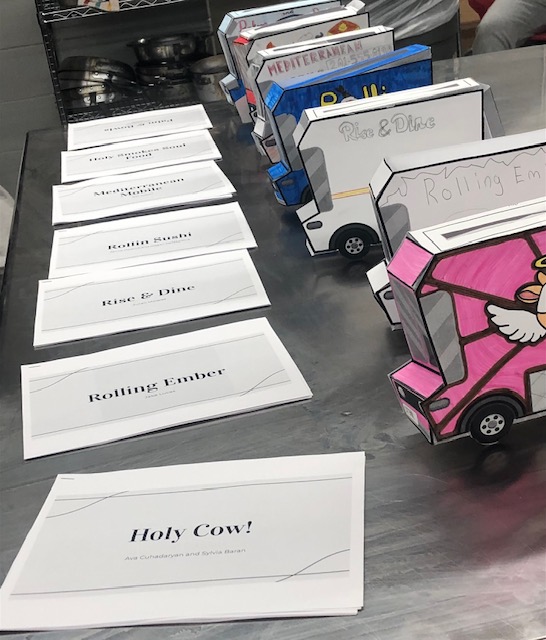
If you were by the Culinary Arts room (room 102) this morning, you would have seen an interesting sight. Seven paper food trucks were lined up on a table with printed business plans in front of them. With catchy names like “Rollin’ Sushi”, “Rise & Dine”, and “Holy Cow!”, these colorful projects represented the creative culmination of a unit regarding food and finance.
Business teacher John Mazola stated, “Students were challenged to create their own food truck business from the ground up. This wasn’t just about designing a truck — they built a full business plan that included demographic research, a geographic pricing strategy, competitor analysis, and a social media marketing campaign. They also developed a Canva-designed menu and constructed a fully realized food truck model.”
He went on to say, “The goal was to help students understand that successful businesses require more than a good idea — they require putting in the time to plan, research, and creatively design each aspect of the operation.”
When asked what aspect of this project he believed the students enjoyed the most, Mazola responded, “The competitive element and physically designing the truck were probably the most exciting parts for students. Many students learned a lot about real business by crafting their business plans, developing social media campaigns, and designing professional-looking menus. They enjoyed taking ownership over the process of creating their own business based around food – something everybody likes.”
Obviously, there are challenging facets to any creative endeavor such as this. Mazola shared, “The most challenging component for many students was pricing strategy and market research. Determining how to price products competitively while still earning a profit required real analysis and critical thinking. However, this challenge became one of the most valuable lessons of the project. Students learned firsthand that nearly 90% of businesses fail due to poor planning and lack of research — and they saw why diligent preparation is essential for success.”
He noted, “What stood out most was the level of engagement. The project captured not only the attention of the current class but also sparked interest from other students who asked if they could do a similar project in their courses. It blended creativity with real-world business skills in a way that felt authentic and exciting.”
In any competition, there are those pieces that have a stand-out quality, and Mazola gave a nod to two trucks in particular.
He admitted, “… two standouts were Palm & Bowls, inspired by the popular concept of tropical smoothie and açaí-style bowls, and Holy Cow!, a burger truck that cleverly blended classic comfort food with healthier options.”
Mazola clarified, “What made these projects exceptional was the depth of their research and the cohesiveness of their branding. Their menus were thoughtfully priced based on market research, visually appealing, and aligned with their target demographic. They also incorporated strong branding elements, including creative taglines and inspirational quotes that reinforced their identity.”
Students and teachers were invited to participate in judging the food trucks’ designs, menus, and plans, and cast their votes by depositing paper “dollars” into the truck of their choice.
Junior Lily Downing said, “I thought this was such a cool project to see, I loved seeing my fellow classmates ideas and how they would create the trucks!”
Downing added, “Making the trucks seemed so fun, I know I would have enjoyed that.”
Wrapping up, Mazola declared, “Overall, it was a tremendous success — and proof that when students are given a creative project with good classroom leadership, they rise to the challenge.”